Jakob Nielsen
The next cognitive trade-off
You may have heard of the cognitive trade-off theory. It was first researched by Tetsuro Matsuzawa at Kyoto University, who demonstrated that young chimpanzees could beat humans in memory tasks involving numbers flashed on a screen for a fraction of a second. The chimpanzees were able to instantly recall how many numbers were on the screen.
Humans can actually do this too. If you show someone a bunch of objects on a screen for a split second, it is impossible to sit there and count them, yet you will find most people's estimates are spot-on accurate (though not as quick as a chimpanzee's). It is a fun little experiment, and you would be surprised at how good you are at estimating numbers you had no time to count.
The core of this trade-off theory is that humans traded this rapid, immediate sensory awareness in order to develop the capacity for slower, more difficult tasks: rational thinking, complex reasoning, and symbolic thought. It came at a cost; we did not retain that rapid processing ability.
With the advent of AI, I feel we are now at a new inflection point where a cognitive trade-off is going to happen again. This time, however, rather than trading off one internal ability for another, we are going to delegate.
We are going to take the difficult, high-effort reasoning that we as humans naturally dislike doing—the friction we often try to avoid—and lean heavily into our autonomous 'System 1' thinking (if you accept to Daniel Kahneman's explanations of how we think). We are going to go back to those shortcuts and comforts, delegating the harder cognitive tasks to an AI instead.
For the first time, we are delegating our cognitive reasoning to an external, alien intelligence. This brings us to a critical point where we have to think about the consequences and whether this shift is actually a good thing for us.
The Trade-off
Let me give you an example of the trade-off. I use Dovetail, which is a research repository, and one of the great things it can do is transcribe conversations and perform thematic analysis across a large body of text.
What would normally have taken hours or even days—sometimes requiring a whole team to split the job of going through interviews, writing sticky notes with tags, grouping them, analysing the data, writing up findings, and creating clips—you can now hand over to an AI agent. AI is actually pretty good at thematic analysis; it will go over your content and do a great job of theming it.
However, it does not always get it right because it lacks the full human experience and context.
To use an analogy, AI in cars is going to be—or already is—safer than humans driving. But when it does go wrong, it goes wrong spectacularly because it lacks human awareness. For example, a Tesla was involved in a fatal accident because it drove straight into a giant truck on a highway. It had no LiDAR, and because the truck was white and the sun was very bright, the truck was essentially washed out in the computer's vision. The car went to change lanes, did not see the truck, and drove straight into it.
Equally, I have seen Google Maps tell me to drive literally off the edge of a cliff. We are already seeing people make this cognitive trade-off to AI and automated systems, blindly following satnav into places they should know to avoid, simply because they are not applying their own diligence over the top.
So, we have real-world examples of this happening already: when AI makes mistakes, it gets them really wrong, and people who are overly reliant on it find themselves in dangerous situations.
But the trade-off does not end with these occasional, spectacular errors. What are we actually getting out of the AI in exchange?
First, it is doing the work much faster, so we are gaining time. We can use that saved time to be more productive elsewhere, or we can use it to carefully review the AI's output.
There is a fallacy that a human would have done the equivalent job to a better standard, even if it took them ten times as long. That is simply not true. When tasks take twice, three times, or ten times as long, you get tired. Your attention span drifts, and you start to make predictably human mistakes.
This is why the trade-off is sometimes overstated. People do not realise that humans are also fallible. Machines never used to be fallible in this way—it was simply garbage in, garbage out. Now, with non-deterministic systems, they operate on probability and make mistakes, but not to the same level as a tired human.
Now, you might think I am making a case for how wonderful AI is and why we should all switch over. I am not, actually. I want to get into the more severe consequences of this cognitive trade-off.
Consequences
Think about the long-term consequences of repeatedly delegating the more uncomfortable, slow reasoning and symbolic tasks we discussed earlier. If you continuously avoid doing those things, a few things happen.
First of all, cognitive skill is not like riding a bike. You don't just learn it once and keep it forever. It is more like speaking a language: you need to practice continuously to remain fluent. The more you delegate, the worse you get at doing it when a situation arises where you actually need to.
I do not believe you can leap from simple, rudimentary skills straight to taste, experience, and wisdom. Each step needs to be practiced to progress up the chain. If you extract the link where we have to think and reason for ourselves, you will eventually lack the ability to articulate taste, to articulate wisdom, and to make the strategic decisions that people claim will remain in the human gamut.
I believe this to be true because of what we see in hiring today. Companies only want to hire senior people. Those senior individuals all went through a progression: learning where to click on a tool, learning how to use that tool effectively, and then learning how to use those tools to make more strategic decisions. We have never been able to skip to the end of that progression. In my trade, for example, people do not become design directors overnight; they have to first learn how to design. By delegating to AI, we are basically cutting out that entire foundational section. That is my first real concern.
My second concern is that we find ourselves delegating so much to this alien system that it holds all the information, creating a circular loop. If we go back to the concept of 'garbage in, garbage out', we get a cycle of 'AI in, AI out', then 'AI back in, AI out'. Like a game of telephone, it will start to output increasingly bizarre results, and hallucinations will get worse and worse.
There is a term for this (model collapse) where AI runs out of organic data to learn from because it has consumed all of human written knowledge. Once it has to train on synthetic AI-generated data, we run a real risk that it will be unable to develop any further, creating a ceiling on its capabilities. We won't be able to push the envelope ourselves to reach new frontiers because we will have basically trained that capacity out of ourselves.
This leads to the main day-to-day consequence: we are simply no longer intimate enough with what we are doing, our responsibilities, and the consequences of our choices. We don't even understand why decisions are made, and that is never going to lead to good outcomes.
Benefits
What about the benefits then? Well, speed, right? You can do these things at a much faster rate. A machine doesn't get tired. If we're honest, it's all the same benefits that machines have given us up to this point.
Every new leap in technology goes through the same cycle: adoption, then bubbles bursting, whether it's steam trains or the internet. It's very cyclical. Things get wrapped up in thought leaders going around showing you 'new' ways of thinking to solve problems, which are just the old ways wrapped in the new thing.
But we do make steady progress. Things do seem to be improving exponentially, right? But also, the risks increase exponentially. We should see lots of benefit when these tools are used well.
Conclusion
So, those are my thoughts on this next cognitive trade-off. Looking back at what I said, rather than trading one skill for another, we will be indirectly trading off one skill for another. In many ways, we are regressing. We'll be going back to our more internal, instinctual systems, using those biases and automatic behaviours because they're more comfortable. We'll be delegating more of the harder thinking to this aid, and we're going to have to make the trade-offs that come with it. I think it's inevitable, and we'll see where it lands us.
End.
Random Quote
To design an easy-to-use interface, pay attention to what users do not what they say.
Good Reads
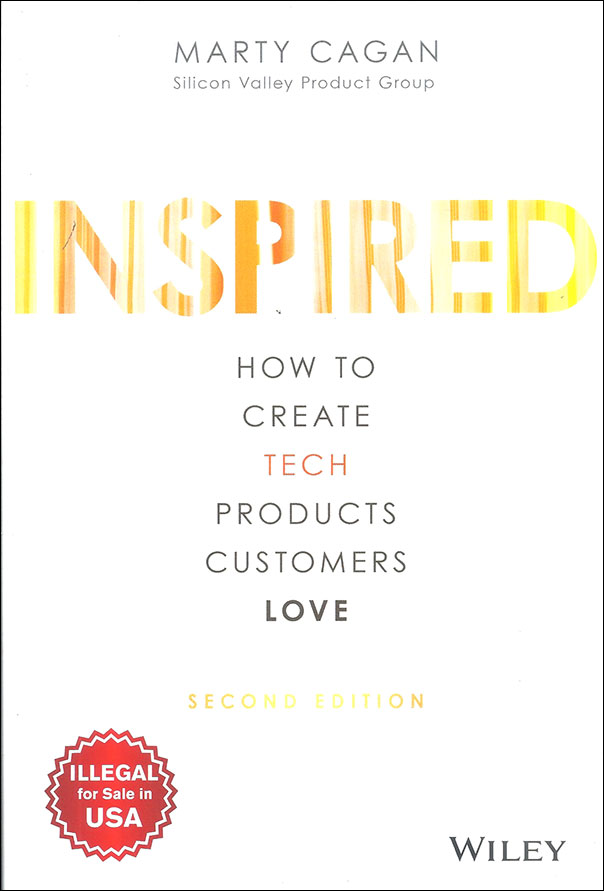
Inspired - How to build tech products customers love